
Export License in Nigeria, The Complete NEPC Registration Guide for 2026
An export license in Nigeria is the legal gateway between a local business and the global market. Without it, no exporter can legally ship goods outside the country. You also cannot access export incentives or open the right banking channels for foreign trade. Yet most guides online quote outdated fees and vague timelines. These figures no longer match what the Nigerian Export Promotion Council actually charges.
This article corrects that. Every validity period and document requirement comes directly from NEPC’s official portal. We verified each detail at the source, rather than copying secondhand blog posts. You will learn exactly how the export license in Nigeria works. This includes the real cost structure and how long your certificate stays valid.
What Is an Export License in Nigeria
An export license in Nigeria is officially called an Exporter’s Certificate. The Nigerian Export Promotion Council issues it to any business intending to sell goods or services outside Nigeria. Without this certificate, customs will not clear your export shipment, and your bank cannot process the required trade documentation.
NEPC operates as the Federal Government’s apex institution for export promotion and diversification. It governs non oil exports specifically. Crude oil and gas exports fall outside NEPC’s mandate entirely. Companies in that sector instead deal with the Nigerian Upstream Petroleum Regulatory Commission. This body replaced the former Department of Petroleum Resources after the Petroleum Industry Act 2021.
This distinction matters. Many older articles still reference the Department of Petroleum Resources as the petroleum regulator. That agency no longer exists in that form. Any exporter dealing with oil or gas must direct licensing enquiries to NUPRC instead.
Who Needs an Export License in Nigeria
Any business entity intending to export products or services from Nigeria needs this certificate first. Before NEPC reviews anything, two requirements apply to every applicant. You need a valid Tax Identification Number from the Federal Inland Revenue Service. You also need an active corporate bank account in your business name.
NEPC then recognizes three categories of applicants beyond this baseline. Each category submits a different set of additional supporting documents.
1. Limited Liability Companies
If you registered your business as a limited liability company, NEPC requires:
- Certificate of Incorporation issued by CAC
- Certified copy of your Memorandum and Articles of Association
- Form CAC 1.1, previously known as Form C07
2. Co-operative Societies
If your business operates as a registered co-operative society, NEPC requires:
- Certificate of Registration from the relevant state Ministry of Commerce
- Bye laws of the society
3. Government or Non Government Organizations
If you represent a government body or an NGO intending to export, NEPC requires:
- Certificate of Registration issued by CAC
- Constitution document of the organization
NEPC does not issue export licenses to businesses registered only as business names. If your business falls into that category, you must upgrade to a limited liability company before applying.
If you have not yet incorporated your business, start with our guide on business registration in Nigeria. It walks through the CAC process every exporter must complete first.
How to Get an Export License in Nigeria, Step by Step
NEPC structures its own onboarding process around nine clear stages. Following this exact sequence keeps your export license in Nigeria application accurate and reduces the risk of rejection.
Step 1: Check Your Export Readiness
NEPC provides an export readiness checker on its portal before you register anything. This tool flags gaps in your business setup early, so you fix them before submitting a formal application.
Step 2: Complete E-Registration
This is the actual licensing step. You create an account on the NEPC e-registration platform and upload your incorporation documents. NEPC only accepts this registration online. No manual or paper based alternative exists for applicants.
Step 3: Understand Your Target Market
Before shipping anything, research the regulatory requirements of your destination country. Many markets demand specific certifications beyond what Nigeria requires domestically.
Step 4: Build an Export Plan
NEPC provides a free template covering pricing, logistics, and target markets. Using their structure increases your chances of qualifying for later export incentives.
Step 5: Prepare Export Documents
This stage produces the paperwork customs and your bank will demand for every shipment. The most critical document here is the Form NXP. Authorized dealer banks issue this form to capture the value of each export transaction.
Step 6: Arrange Logistics and Freight
Confirm shipping terms, delivery timelines, and the freight forwarder you intend to use. Errors at this stage often delay shipments even after your export license in Nigeria has already been approved.
Step 7: Set Your Export Pricing
Calculate your costs accurately, including freight, insurance, and currency conversion. Underpricing exports is one of the most common reasons new exporters lose money in their first year.
Step 8: Secure Export Financing
Export businesses often need working capital ahead of payment from foreign buyers. NEPC’s portal outlines available financing routes for registered exporters.
Step 9: Review Legal Requirements
Finally, confirm the legal instruments governing your specific product, both in Nigeria and your destination market. Agricultural products, for instance, often need phytosanitary certificates that NEPC registration alone does not cover.
Export License Nigeria, Cost Structure and Validity
NEPC structures its charges around four distinct stages, rather than one flat fee. Understanding this structure matters more than memorizing a number, since government fees can change without much public notice.
| Item | Cost Tier | Notes |
|---|---|---|
| New certificate registration | Lowest tier | The standard charge for a first time exporter |
| Expired certificate renewal | Mid tier | Applies once your initial validity period lapses |
| Late certificate renewal | Highest tier | Charged once renewal is overdue by several months |
| Initial validity period | 24 months | First certificate issued covers two full years |
| Renewal cycle after initial period | 12 months | Annual renewal required thereafter |
| Processing time after payment | 1 working day | Delays occur only with incomplete documents |
Several articles online quote fixed naira figures for these stages. Treat any specific number with caution. NEPC reviews its fee schedule periodically, and outdated figures circulate long after a revision. Confirm the current charge directly on the NEPC e-registration platform before making payment. Separate any agent’s professional service fee from NEPC’s own statutory charge. The two are frequently bundled together in misleading estimates.
How to Renew Your Export License in Nigeria
NEPC manages every renewal exclusively online, with no manual or paper based alternative. The full process typically takes 24 to 48 hours once you submit a complete application.
Steps to Renew Your Certificate
- Log in to the NEPC e-registration platform using your existing account
- Navigate to the registration details or renewal section and complete the online form
- Generate a payment reference and pay through the Remita platform
- Download and print your renewed certificate directly from your dashboard once payment clears
Physical certificate pickup has been discontinued entirely. Every renewed certificate now exists only as a digital download from your NEPC dashboard.
Late renewal carries a real financial penalty once you cross the three month mark past expiry. This penalty sits on top of the standard renewal charge. Track your certificate’s expiry date closely rather than waiting for a reminder that may not arrive.
Documents Needed for Renewal
Keep these documents current and ready to upload during the renewal process:
- CAC Certificate of Incorporation or Business Name
- Certified true copies of your Memorandum and Articles of Association
- Current tax clearance certificate
- Board resolution authorizing the company to export, for limited liability companies
A common error here involves submitting an outdated tax clearance certificate. NEPC checks that this document reflects your current filing year, not a certificate from a previous renewal cycle.
Required Documents for Export License Nigeria
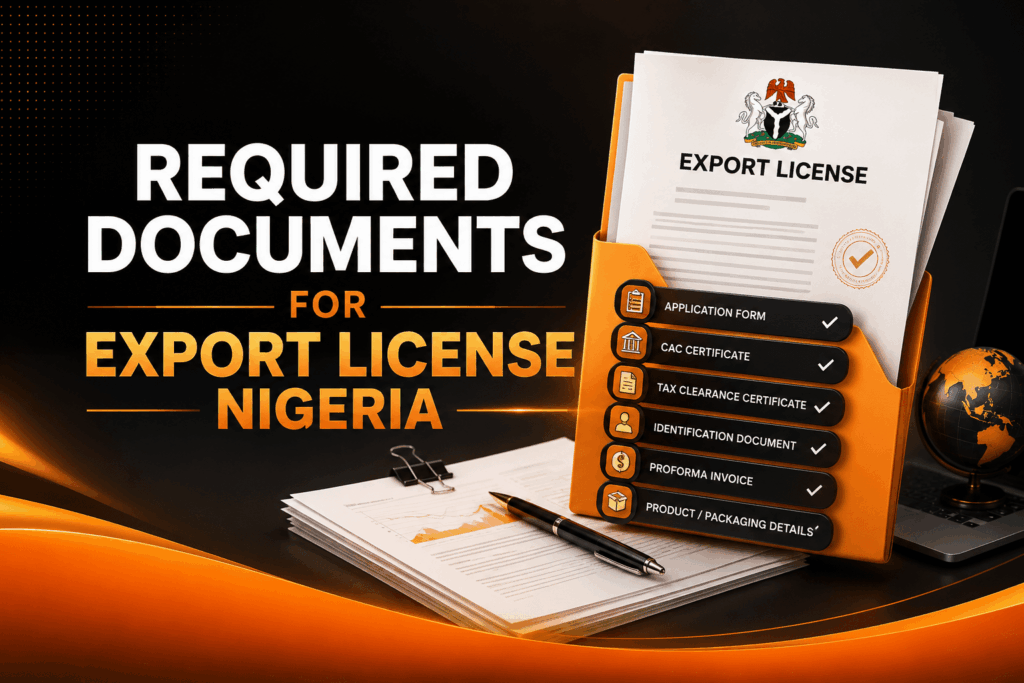
Document requirements for export license in Nigeria fall into two distinct stages. The first stage covers what NEPC needs before granting your certificate. The second stage covers what customs and your bank need before every individual shipment leaves the country.
Documents Needed for NEPC Registration
- Tax Identification Number certificate from FIRS
- Entity specific incorporation documents, as outlined for your business type above
- Completed NEPC exporter registration form
- Valid means of identification for company directors or owners
- Passport sized photographs of directors or owners
- List of products or services you intend to export
- Company contact information and corporate bank details
Documents Needed for Each Shipment
Once registered, every individual export transaction requires its own supporting paperwork. These include:
- Export contract between you and your buyer
- Commercial invoice stating transaction value
- Proforma invoice describing the goods and their value
- Form NXP, processed through your authorized dealer bank
- Bill of lading or shipping document confirming transport
- Payment receipts for any applicable fees
Conditional Documents by Product Type
Certain products trigger additional requirements beyond the standard list. If SON or NAFDAC regulates your goods, you need a product specific certificate before shipment. Agricultural exports often require a quarantine or phytosanitary certificate. Some shipments also need a pre-shipment inspection certificate to confirm quality and proper valuation before goods leave Nigeria.
Our guide on documents required to register a business in Nigeria covers the foundational paperwork every company needs first.
Export License in Nigeria for Foreign Owned Companies
Foreign investors exporting from Nigeria face an additional compliance layer. Beyond NEPC registration, most foreign owned export businesses must also complete registration with the Nigerian Investment Promotion Commission. This step protects foreign capital and confirms the company’s standing to operate in Nigeria’s trade sector.
Our detailed guide on NIPC registration in Nigeria explains this parallel requirement fully. If your company has direct foreign shareholding, our article on foreign participation in Nigerian business clarifies the ownership rules first.
Common Mistakes Exporters Make in Nigeria
Many new exporters assume their export license in Nigeria covers every product automatically. It does not. Product specific certifications from SON or NAFDAC sit entirely separate from your NEPC certificate. Skipping them stops shipments at the port, regardless of your NEPC status.
Another frequent mistake involves the company’s CAC objects clause. NEPC checks that your Memorandum and Articles of Association explicitly mention export activity. A company registered only for domestic trade cannot simply start exporting without first amending its objects clause through CAC.
Renewal timing also catches exporters off guard. Many forget that the initial certificate runs for twenty four months, then shifts to annual renewal afterward. Missing that window triggers the highest late renewal charge once you fall several months past expiry.
Frequently Asked Questions
What is the cost of an export license in Nigeria?
NEPC charges in tiers rather than one flat amount. A new certificate sits at the lowest tier, renewal after expiry sits higher, and late renewal carries the highest charge. Always confirm the current figure directly on NEPC’s portal, since government fees change periodically.
How long does an export license in Nigeria remain valid?
NEPC issues the initial certificate for twenty four months. After that period, it becomes renewable annually, so exporters must track their renewal date closely.
How do I renew my export license in Nigeria?
Log in to the NEPC e-registration platform, complete the online renewal form, and pay through Remita. Your renewed certificate downloads directly from your dashboard, since NEPC no longer issues physical pickups.
How long does NEPC take to issue an export license?
NEPC issues certificates between one to two working day after confirming payment, provided all submitted documents are complete and accurate.
Can NEPC issue a license for oil and gas exports?
No. NEPC governs non oil exports only. Crude oil and gas exporters must instead deal with the Nigerian Upstream Petroleum Regulatory Commission.
Do I need CAC registration before applying for an export license in Nigeria?
Yes. NEPC requires a valid Certificate of Incorporation, along with your Memorandum and Articles of Association, before processing any application.
Does an export license in Nigeria cover product specific certifications?
No. Products regulated by SON or NAFDAC need separate certifications. Your NEPC certificate only authorizes your status as a registered exporter.
Final Thoughts on Export License in Nigeria
Securing an export license in Nigeria opens the door to international trade. The certificate alone, however, does not guarantee a smooth export business. Success depends on pairing NEPC registration with accurate product certifications, sound pricing, and consistent compliance.
Pukka Services helps businesses across Nigeria navigate NEPC registration correctly the first time. We help you avoid the fee confusion and document errors that delay most applications. Contact our team today to secure your export license in Nigeria and reach international markets.
Contact Information:
- Phone: +234 1 454 9191 | +234 805 834 4034 | +234 816 323 7168
- Email: info@pukkalogistics.com.ng
- Website: www.pukkalogistics.com.ng