
Import License in Nigeria: Complete Guide to Import Permits, Form M & Customs Requirements (2026)
Introduction
Importing goods into Nigeria creates opportunities for manufacturers, distributors, retailers, and foreign investors. However, successful importation involves more than purchasing goods overseas. Businesses must comply with customs procedures, documentation requirements, and product-specific regulatory approvals before shipments can be cleared.
Understanding the requirements for an Import License in Nigeria helps businesses avoid customs delays, shipment seizures, regulatory penalties, and unnecessary compliance costs. Depending on the products being imported, approvals may also be required from agencies such as the Nigeria Customs Service (NCS), the Standards Organisation of Nigeria (SON), the National Agency for Food and Drug Administration and Control (NAFDAC), and other government regulators.
Many businesses assume Nigeria operates a single import licence for every shipment. In reality, imports are regulated through a broader compliance framework that includes company registration, a Tax Identification Number (TIN), Form M, the Pre Arrival Assessment Report (PAAR), customs documentation, and additional permits for regulated products.
This guide explains everything you need to know about obtaining an Import License in Nigeria, including the documents required, the agencies involved, the import process, and the compliance obligations businesses must meet before goods can enter Nigeria legally.
Do You Need an Import License in Nigeria?
Many businesses ask whether every importer must obtain an Import License in Nigeria. The answer depends on the products being imported and the regulations that govern them.
Unlike some countries that issue a universal import licence, Nigeria regulates imports through customs procedures, statutory documentation, and product-specific approvals. Most businesses do not obtain a standalone import licence. Instead, importers must satisfy the requirements of the government agencies responsible for customs administration, product safety, public health, agriculture, and national security.
Before importing commercial goods, businesses will generally need:
- A company registered with the Corporate Affairs Commission (CAC)
- A valid Tax Identification Number (TIN)
- An active corporate bank account
- An approved Form M processed through an Authorised Dealer Bank
- A Pre Arrival Assessment Report (PAAR), where applicable
- Additional permits for regulated products
For example, food, beverages, cosmetics, pharmaceuticals, and medical devices require approvals from NAFDAC. Products covered by mandatory standards may require compliance with the Standards Organisation of Nigeria Conformity Assessment Programme (SONCAP), while agricultural products may require certification from the Nigeria Agricultural Quarantine Service (NAQS).
Before arranging shipment, businesses should confirm the regulatory requirements that apply to their specific products.
If you are establishing a business to import goods into Nigeria, begin with company registration through the Corporate Affairs Commission. Read our guides on Business Registration in Nigeria and for businesses operating through overseas entities should also see How to Register a Foreign Company in Nigeria.
Import License vs Import Permit vs Form M
Many businesses use the terms Import License, Import Permit, and Form M interchangeably. Although they are closely related, they serve different purposes within Nigeria’s import regulatory framework. Understanding the distinction can help businesses avoid costly delays and unnecessary compliance issues.
| Import License | General term commonly used to describe the approvals required to import goods into Nigeria. In most cases, it refers to the overall import compliance process rather than a single licence. | Varies depending on the goods being imported. | Businesses importing commercial goods. |
| Import Permit | A specific approval required for regulated products such as food, pharmaceuticals, chemicals, plants, animals, firearms, telecommunications equipment, and other controlled items. | Relevant sector regulator such as NAFDAC, SON, NAQS, NCC, or other government agencies. | Importers of regulated products. |
| Form M | A mandatory electronic import declaration processed before shipment. It provides details of the importer, supplier, goods, value, insurance, freight, and payment arrangements. | Processed through an Authorised Dealer Bank and administered under the Nigeria Customs Service import documentation framework. | Required for most commercial import transactions. |
For many businesses, Form M is one of the most important documents in the import process. Without an approved Form M, the Nigeria Customs Service cannot process a Pre Arrival Assessment Report (PAAR), making customs clearance impossible for most commercial shipments.
Importers dealing with regulated goods must also obtain the relevant import permits before shipment. For example, food products, pharmaceuticals, cosmetics, medical devices, and packaged drinking water require approvals from NAFDAC, while many manufactured products must comply with the Standards Organisation of Nigeria Conformity Assessment Programme (SONCAP).
Understanding which approvals apply to your products before shipment leaves the exporting country can significantly reduce customs delays and storage costs.
Key Regulators of Imports in Nigeria?
Obtaining an Import License in Nigeria often involves more than one government agency. While the Nigeria Customs Service manages customs clearance, several specialised regulators oversee specific categories of imported products.
The table below outlines the principal government agencies involved in Nigeria’s import regulatory framework.
| Nigeria Customs Service (NCS) | Customs clearance, tariff classification, PAAR processing, import duties, cargo release, and border enforcement. |
| Central Bank of Nigeria (CBN) | Foreign exchange policies relating to imports and oversight of Form M processing through Authorised Dealer Banks. |
| Standards Organisation of Nigeria (SON) | Product standards, SONCAP compliance, and quality conformity for regulated manufactured products. |
| National Agency for Food and Drug Administration and Control (NAFDAC) | Regulation of imported food, beverages, pharmaceuticals, cosmetics, chemicals, medical devices, and related products. |
| Nigeria Agricultural Quarantine Service (NAQS) | Inspection and certification of agricultural products, plants, animals, seeds, and related commodities entering Nigeria. |
| Nigerian Ports Authority (NPA) | Port infrastructure management and coordination of cargo handling within Nigerian seaports. |
| National Environmental Standards and Regulations Enforcement Agency (NESREA) | Environmental compliance for regulated imports, hazardous materials, and environmentally sensitive products. |
Each agency performs a distinct role during the import process. Depending on the nature of your shipment, you may only interact with one or two regulators, while highly regulated industries may require approvals from several agencies before customs clearance is completed.
Businesses importing food, pharmaceuticals, cosmetics, chemicals, agricultural products, telecommunications equipment, or industrial machinery should always verify whether additional sector specific approvals apply before shipping their goods.
Step by Step process for obtaining an import license in Nigeria
Understanding the import process before placing an overseas order helps businesses avoid delays, unexpected costs, and compliance problems. Although the exact requirements vary depending on the products being imported, most commercial import transactions follow the same regulatory sequence.
Step 1. Register Your Business
Commercial importation into Nigeria generally requires a registered business entity. Most importers operate through a company registered with the Corporate Affairs Commission (CAC).
If you are yet to register your business, our guides on Business Registration in Nigeria and Documents Required to Register a Business in Nigeria explain the registration process and documentation in detail.
Step 2. Obtain a Tax Identification Number (TIN)
After incorporation, your company should obtain a Tax Identification Number (TIN). The TIN is required for banking, customs documentation, tax administration, and several government regulatory processes connected with importing goods.
Step 3. Open a Corporate Bank Account
Import transactions involving Form M must be processed through an Authorised Dealer Bank approved by the Central Bank of Nigeria.
The bank verifies import documentation, processes Form M applications, facilitates foreign exchange transactions where applicable, and communicates with the Nigeria Customs Service during the import process.
Step 4. Process Form M
Before goods are shipped to Nigeria, the importer must complete Form M through an Authorised Dealer Bank.
Information normally required includes:
- supplier information,
- commercial invoice,
- product description,
- Harmonised System (HS) codes,
- insurance details,
- freight information,
- country of origin,
- pro forma invoice,
- payment terms.
Form M serves as the official declaration that initiates Nigeria’s import documentation process.
Step 5. Obtain Product Specific Approvals
Depending on the products being imported, additional approvals may be required before shipment.
Examples include:
- NAFDAC approvals for food, pharmaceuticals, cosmetics, medical devices, and chemicals.
- SONCAP certification for regulated manufactured products.
- NAQS permits for agricultural products, seeds, plants, and animal related imports.
- Other permits issued by specialised regulators for controlled products.
Obtaining these approvals before shipment helps prevent cargo detention and unnecessary storage charges at Nigerian ports.
Step 6. Secure the Pre Arrival Assessment Report (PAAR)
Once Form M has been processed and supporting documentation submitted, the Nigeria Customs Service issues a Pre Arrival Assessment Report (PAAR), where applicable.
PAAR provides Customs with advance information about the shipment, enabling import duty assessment before the cargo arrives in Nigeria.
Without a valid PAAR, customs clearance may be delayed significantly.
Step 7. Customs Clearance and Duty Payment
When the shipment arrives in Nigeria, the importer or licensed customs agent submits the required customs documentation through the Nigeria Customs Service.
Customs officers assess:
- customs duties,
- import levies,
- applicable taxes,
- regulatory compliance,
- inspection requirements.
After all statutory payments have been made and compliance requirements satisfied, Customs authorises the release of the goods.
Step 8. Delivery of Goods
Following customs release, the goods can be transported from the port to the importer’s warehouse, factory, distribution centre, or final destination.
Businesses should retain all import documentation for future audits, tax purposes, warranty claims, and regulatory inspections.
Required Documents for an Import License in Nigeria
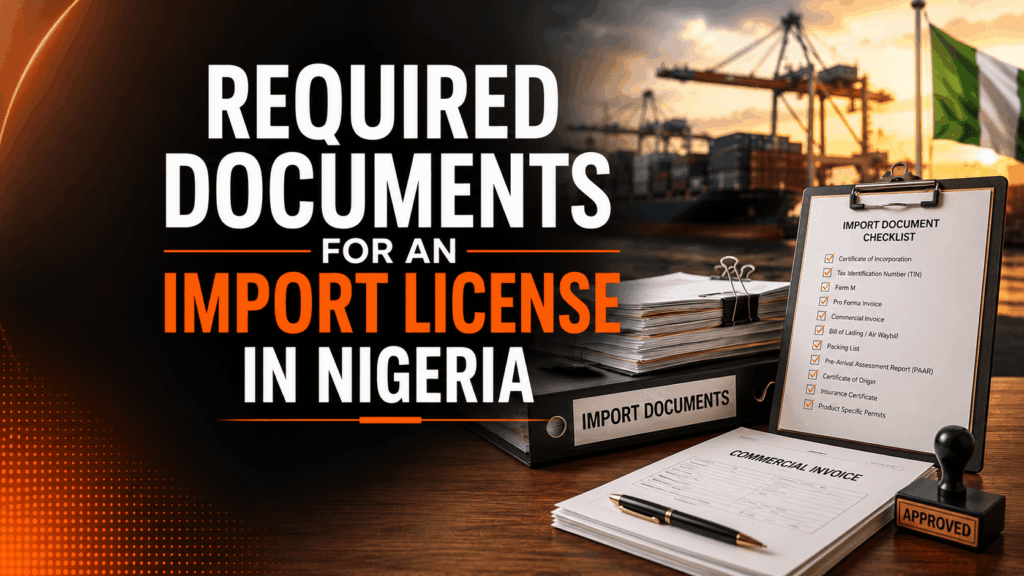
Before importing goods into Nigeria, businesses should ensure they have all the required documentation in place. Missing or inaccurate documents are among the most common reasons shipments are delayed at Nigerian ports.
Although documentation requirements vary depending on the nature of the goods, most commercial import transactions require the following documents.
| Document | Purpose |
|---|---|
| Certificate of Incorporation | Confirms the importer is a legally registered business in Nigeria. |
| Tax Identification Number (TIN) | Required for tax administration and customs documentation. |
| Corporate Bank Account | Used by an Authorised Dealer Bank to process Form M and import payments. |
| Form M | Mandatory electronic import declaration processed before shipment. |
| Pro Forma Invoice | Provides details of the supplier, goods, pricing, and payment terms before shipment. |
| Commercial Invoice | Confirms the final transaction value for customs assessment. |
| Bill of Lading or Air Waybill | Serves as evidence that the goods have been shipped. |
| Packing List | Describes the contents, quantity, dimensions, and packaging of the shipment. |
| Pre Arrival Assessment Report (PAAR) | Enables customs valuation and clearance before the shipment arrives. |
| Certificate of Origin | Confirms the country where the goods were manufactured. |
| Insurance Certificate | Demonstrates cargo insurance where applicable. |
| Product Specific Permits | Required for regulated products such as food, pharmaceuticals, chemicals, agricultural products, and telecommunications equipment. |
Businesses importing regulated products should also obtain any sector specific approvals before shipment leaves the exporting country. Waiting until the cargo arrives often results in avoidable delays, storage charges, or customs detention.
Products That Require Additional Permits Before Obtaining an Import License in Nigeria
Not every product can be imported using only Form M and standard customs documentation. Several categories of goods require approvals from specialised government agencies before they can enter Nigeria.
Understanding these additional requirements early helps businesses plan their import process more efficiently and reduces the risk of customs delays.
| Food and beverages | National Agency for Food and Drug Administration and Control (NAFDAC) | Product registration or import permit where applicable. |
| Pharmaceuticals and medical devices | NAFDAC | Product registration, import authorisation, and regulatory compliance. |
| Cosmetics and household chemicals | NAFDAC | Product registration and safety compliance. |
| Agricultural products, seeds, plants, and animals | Nigeria Agricultural Quarantine Service (NAQS) | Quarantine inspection and phytosanitary certification where required. |
| Manufactured consumer products | Standards Organisation of Nigeria (SON) | SONCAP certification for regulated products. |
| Telecommunications equipment | Nigerian Communications Commission (NCC) | Equipment type approval where applicable. |
| Petroleum products | Nigerian Midstream and Downstream Petroleum Regulatory Authority (NMDPRA) | Import authorisation and sector specific approvals. |
| Firearms and controlled security equipment | Office of the National Security Adviser and other authorised agencies | Government approval before importation. |
Importers should always verify whether their products fall within Nigeria’s regulated import categories before placing an international order.
Import License in Nigeria Timeline
The time required to complete an import transaction depends on the nature of the goods, the regulatory approvals required, and the accuracy of the documentation submitted.
The table below provides a general timeline for a standard commercial import.
| Stage | Estimated Timeline |
|---|---|
| Company incorporation (if required) | 3–10 working days |
| Tax Identification Number (TIN) | Usually issued after CAC registration |
| Product-specific regulatory approvals | Varies by regulator and product |
| Form M processing | 2–7 working days |
| PAAR issuance | Usually several working days after complete documentation is submitted |
| Shipment | Depends on origin country and shipping method |
| Nigeria Customs clearance | Commonly 3–14 days where documentation is complete |
Actual processing times vary depending on the product category, shipping route, inspections, and regulatory requirements.
Cost of Obtaining an Import License in Nigeria
There is no single government fee called an import license fee in Nigeria.
Instead, importers should budget for several compliance costs that vary depending on the goods being imported and the regulatory agencies involved.
These costs may include:
| Possible Cost | Notes |
|---|---|
| Company registration | Applicable if the importer has not incorporated a Nigerian company. |
| Form M processing | Bank processing charges may apply. |
| Regulatory approvals | Fees vary depending on the regulator and product category. |
| PAAR processing | Subject to applicable customs procedures. |
| Import duties and taxes | Calculated based on product classification, customs value, and applicable tariff. |
| Port handling and terminal charges | Vary depending on the port and shipping arrangements. |
Because government charges and customs duties differ by product classification, importers should obtain current quotations before commencing the import process.
Frequently Asked Questions About Import License in Nigeria
Do I need an Import License in Nigeria for every product?
No. Most products can be imported through the standard customs process. However, regulated goods require approvals from agencies such as NAFDAC, SON, NAQS, or the NMDPRA.
Is Form M the same as an Import License in Nigeria?
No. Form M is an import declaration processed through an Authorised Dealer Bank. It does not replace any product specific licence or permit.
Can a foreign company obtain an Import License in Nigeria?
Yes. Foreign companies can import into Nigeria, but they must comply with the applicable company registration and investment requirements.
Related guide: How to Register a Foreign Company in Nigeria
Which government agencies regulate an Import License in Nigeria?
The Nigeria Customs Service oversees customs clearance, while agencies such as NAFDAC, SON, NAQS, NMDPRA, and NCC regulate specific imported products.
How long does it take to obtain an Import License in Nigeria?
The timeline depends on the product and the approvals required. Complete documentation usually results in faster processing.
What documents are required for an Import License in Nigeria?
Most importers need a CAC registration, TIN, Form M, PAAR, shipping documents, and any product specific approvals required by law.
Can I import goods before obtaining an Import License in Nigeria?
For regulated products, no. Importing without the required approvals may result in shipment delays, detention, or seizure.
Do I need a registered company before applying for an Import License in Nigeria?
Commercial imports are generally carried out through a registered Nigerian company with the required tax and banking documentation.
How can I know if my products require an Import License in Nigeria?
Check with the relevant regulator before shipment. The applicable requirements depend on the type of goods being imported.
What happens if I fail to comply with Import License in Nigeria requirements?
Non-compliance can result in customs delays, penalties, additional charges, or seizure of the imported goods.
Conclusion
Importing goods into Nigeria involves far more than clearing cargo at the port. From company registration and Form M processing to product-specific approvals, customs documentation, and regulatory compliance, every stage requires careful planning and accurate documentation.
Missing a single requirement can delay shipments, increase costs, or expose your business to avoidable regulatory action.
At Pukka Logistics & Support Services Limited, we help businesses, manufacturers, distributors, foreign investors, and international suppliers navigate Nigeria’s import regulatory framework with confidence. Our team provides end-to-end support, including company registration, regulatory approvals, Form M guidance, customs compliance, and sector-specific licensing.
If you’re planning to import goods into Nigeria or need assistance meeting regulatory requirements, our specialists are ready to help.
Contact Pukka Logistics & Support Services Limited
📞 +234 805 834 4034